

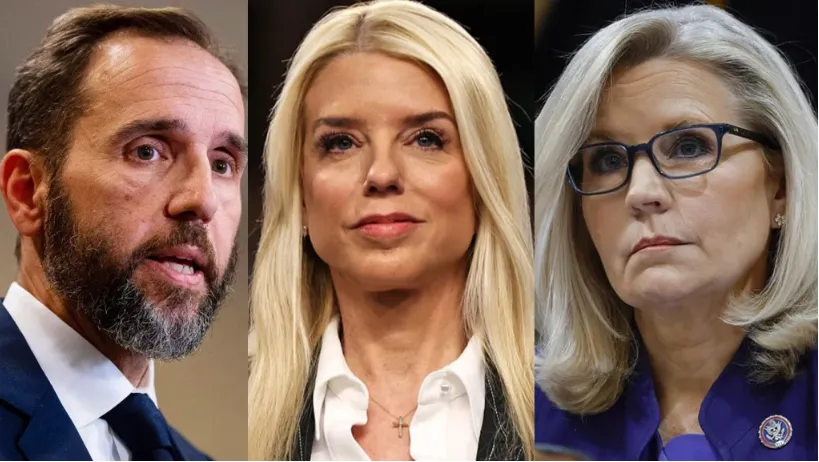
Newly unearthed congressional letters have confirmed the worst fears of Trump supporters — that the January 6th Committee was never about “defending democracy” but about weaponizing government power to destroy President Donald J. Trump.
The shocking letters, released by congressional investigators, show direct coordination between disgraced former Rep. Liz Cheney (R-Wyo.) and Special Counsel Jack Smith, the Biden Justice Department’s top political hitman.
Authored by Cheney and then–Committee Chair Rep. Bennie Thompson (D-Miss.), the two documents reveal that the anti-Trump duo quietly handed over materials from their so-called investigation before Republicans took back the House in 2023.
The letters, dated December 2022, confirm that the Jan. 6 panel transferred at least 16 interviews and deposition transcripts to Smith’s office. These included attached exhibits, text messages, and even spreadsheets detailing Trump administration communications.
One of the letters explicitly stated the committee’s intention to make all gathered evidence “available to the Department of Justice.” That statement alone shatters any illusion of separation between the congressional probe and Smith’s ongoing witch hunt.
Within just four days, Cheney and Thompson wrote again to Smith, this time proudly announcing they had sent text messages from Trump’s then–Chief of Staff Mark Meadows and confidential documents from attorney John Eastman.
“Along with the latter, we are producing a staff-created spreadsheet of the Meadows texts that contain additional information from privilege logs,” they bragged, showing a complete disregard for privacy and executive privilege.
The pair even promised to send “additional evidence on a rolling basis,” effectively making the Jan. 6 Committee an unofficial branch of the Biden Department of Justice.
According to the House Judiciary Committee, these newly revealed communications prove that the partisan panel worked “hand-in-hand” with Smith to politically target Trump and his associates.
Smith, who was personally appointed by Attorney General Merrick Garland, would go on to indict Trump twice — once over a records dispute with the National Archives, and again over Trump’s challenge to the 2020 election results.
The collusion between Cheney’s committee and Smith’s prosecutors shows that the Jan. 6 operation was part of a coordinated effort to criminalize political opposition.
It also raises serious questions about the ethics of lawmakers sharing privileged materials with a prosecutor before their own investigation had even formally concluded.
Many Republicans are now calling it one of the most blatant abuses of congressional power in modern American history.
Rep. Barry Loudermilk (R-Ga.), who is leading the current probe into the Jan. 6 Committee’s activities, says the revelations confirm that the previous panel may have engaged in “criminal or unethical behavior.”
Loudermilk’s new investigation is focused on allegations that the committee deleted files, manipulated evidence, and conducted itself as an arm of the Democratic Party rather than a neutral fact-finding body.
Adding to the outrage, both Cheney and Thompson reportedly received preemptive pardons from President Joe Biden for any actions tied to the Jan. 6 investigation.
That revelation has sparked fury among conservatives, who view the pardons as a blatant attempt to shield political allies from accountability.
The original Jan. 6 Committee was hand-selected by then–Speaker Nancy Pelosi, who barred pro-Trump lawmakers from serving on it — ensuring the panel’s conclusions were politically one-sided from the start.
Cheney, who lost her seat in a landslide after turning on Trump, used her position to promote the Democrat narrative that the former president was responsible for the Capitol riot.
Meanwhile, Thompson oversaw the committee’s public hearings, which featured selectively edited footage, staged testimony, and heavily scripted “evidence” designed to manipulate public opinion.
Now, the release of these letters confirms that behind the scenes, the same individuals who claimed to be seeking “truth” were secretly feeding information to federal prosecutors.
Even worse, that information would later form the backbone of Smith’s politically motivated indictments against President Trump.
The entire saga paints a disturbing picture of government collusion — where congressional Democrats, anti-Trump Republicans, and DOJ officials conspired to weaponize the legal system against a sitting and future president.
For millions of Americans, these revelations only reaffirm what they have long believed: that the Jan. 6 investigation was a partisan hit job masquerading as justice.
In a shocking turn of events, Missouri Rep. Cori Bush, a prominent member of the far-left “Squad,” has lost her congressional seat in a Democratic primary. Her loss marks a significant moment in the political landscape, as she becomes the second Squad member to face defeat, following the loss of Rep. Jamaal Bowman.
With Wesley Bell, St. Louis County prosecutor, leading Bush by a commanding double-digit margin, her political future is now in jeopardy.
Bush, who has served as the representative for Missouri’s 1st Congressional District since 2021, saw her once-promising political career take a drastic turn after her primary defeat.
Bell garnered 54.9% of the vote, while Bush could only manage 41.8%, a clear indication that her support had significantly dwindled. The race was called by Decision Desk HQ after polls closed, and the results were quick to ignite a firestorm of reactions, particularly from Republican figures who wasted no time mocking Bush’s loss.
Wesley Bell, a former prosecutor, emerged as a formidable challenger for Bush. His leadership in St. Louis County has made him a respected figure in local politics, and his win over Bush in the primary reflects a growing desire for change within Missouri’s Democratic Party.
Bell’s focus on criminal justice reform and his track record as a prosecutor who had worked to reduce mass incarceration struck a chord with voters, especially in light of Bush’s increasingly controversial stances.
Bell’s victory marks a critical shift in the political dynamic of Missouri’s 1st Congressional District, which covers St. Louis City and parts of St. Louis County.
As the city grapples with rising crime and calls for police reform, Bell’s message of pragmatic change appears to have resonated more deeply with voters than Bush’s more radical approach to governance.
In the aftermath of Bush’s defeat, Republicans took to social media to mock and ridicule her political loss. Pro-Trump comedian Terrance K. Williams shared his glee over the result, posting on X (formerly Twitter): “A ‘BLACK JOB’ IS SOMETHING CORI BUSH DOES NOT HAVE. OH HAPPY DAY! OH HAPPY DAY. She is the Second Squad member to lose her seat! I can’t wait until they are all gone. They are all full of hate and stupidity. I’m laughing so hard. Who’s laughing with me?”
Florida GOP Rep. Matt Gaetz, known for his sharp criticism of Bush during their time together on the House Judiciary Committee, also took a jab at her defeat. Gaetz tweeted, “I will miss Cori Bush missing every committee meeting.”
His sarcastic comment highlighted the growing frustration among Republicans over Bush’s absence from important committee work, further intensifying the mockery of her loss.
Ryan Fournier, a co-founder of the Students for Trump group, added his own taunt, posting, “The Squad’s Cori Bush has LOST her primary. Join me in saying GOOD RIDDANCE! Hamas might be hiring, Cori!”
This comment referenced Bush’s controversial stances on the Israel-Hamas conflict, which have earned her the ire of both her political opponents and many within her own party.
Actor Michael Rapaport, a vocal supporter of Israel, also weighed in on Bush’s defeat, taking to social media to express his satisfaction. Rapaport posted, “Tonight at the rally they said let’s bring back ‘JOY’ to politics and boom CORI BUSH is done with Politics…. I feel JOY all of a sudden.”
His sarcastic tone underscored the widespread sentiment among Bush’s critics, who saw her defeat as a victory for traditional political norms.
Cori Bush’s political career has been marked by bold stances on a range of issues, from police reform to her support of progressive causes like Medicare for All and the Green New Deal.
However, her tenure in Congress has been fraught with controversy. Since her election in 2020, Bush has been a staunch ally of other members of the Squad, including Reps. Ilhan Omar, Alexandria Ocasio-Cortez, and Rashida Tlaib. Together, they have pushed for sweeping left-wing reforms, challenging the establishment wing of the Democratic Party.
However, Bush’s association with the Squad and her vocal support of controversial movements, such as her alignment with pro-Hamas demonstrators after the October 7th attack on Israel, have drawn significant backlash.
Her remarks and actions following the attack, which was an unprecedented and unprovoked assault on Israel by terrorists affiliated with Hamas, alienated many in her own party, as well as voters who viewed her position as extreme.
Bush’s alignment with pro-Hamas demonstrators, who threatened Jewish students on college campuses and blamed Israel for the ensuing conflict, became a flashpoint in her campaign.
Critics argued that her rhetoric was not only inflammatory but also deeply divisive, further alienating voters who were already grappling with concerns over rising crime and public safety.
In addition to her controversial stance on international issues, Bush has also faced scrutiny over her personal finances. Reports surfaced alleging that she had funneled thousands of dollars to her husband in exchange for “security” services, despite her public calls for defunding the police and reducing law enforcement presence in her district.
These revelations only served to further tarnish her image, as many saw them as hypocritical given her calls for greater public accountability and transparency.
Cori Bush’s defeat comes on the heels of another high-profile loss for the Squad, that of Rep. Jamaal Bowman of New York. Like Bush, Bowman faced a significant challenge in his primary, losing by a large margin despite his strong ties to the far-left wing of the Democratic Party.
Bowman’s loss was partly attributed to his vocal support for pro-Hamas demonstrators, which alienated many Democratic voters who were uncomfortable with his extreme position on the Israel-Palestine conflict.
Both Bush and Bowman have claimed that their losses were not due to their extreme political views but rather to the influence of pro-Israel organizations like AIPAC, which they allege poured significant funding into their challengers’ campaigns.
This claim has been met with skepticism, as many see their losses as more of a reflection of their unpopular stances on key issues, such as national security, crime, and law enforcement.
The defeat of Bush and Bowman signals a potential shift within the Democratic Party, particularly as it grapples with the growing divide between its far-left wing and more centrist factions.
As the party struggles to define its identity in an increasingly polarized political climate, the losses of high-profile Squad members may serve as a wake-up call for the party’s leadership.
While the Squad has garnered significant attention for its progressive agenda, its controversial positions on issues like policing, foreign policy, and economic reform have created tensions within the broader Democratic coalition.
As Democrats look ahead to the 2024 elections, they will need to balance their desire for bold, transformative change with the need to appeal to a broader electorate.
Bush’s defeat, in particular, highlights the challenges faced by progressive candidates who have adopted radical stances on issues that many voters see as out of touch with the mainstream.
As more centrist candidates rise to prominence, it remains to be seen whether the Democratic Party can bridge the gap between its ideological extremes and build a coalition capable of winning national elections.
Cori Bush’s loss in the primary is a significant moment in the ongoing battle for the soul of the Democratic Party. As one of the most vocal and controversial members of the Squad, her defeat will likely have reverberations throughout the political landscape, not just in Missouri but across the nation.
For the Republicans, it represents a major victory, one that they will no doubt continue to capitalize on as they work to expand their influence in upcoming elections.
For Bush, the loss marks the end of what seemed to be a promising political career. Whether or not she can bounce back from this setback remains to be seen. But her defeat, alongside Bowman’s, sends a powerful message to the Democratic Party: the far-left wing of the party may not always be as politically invincible as some might think.


No comments: