

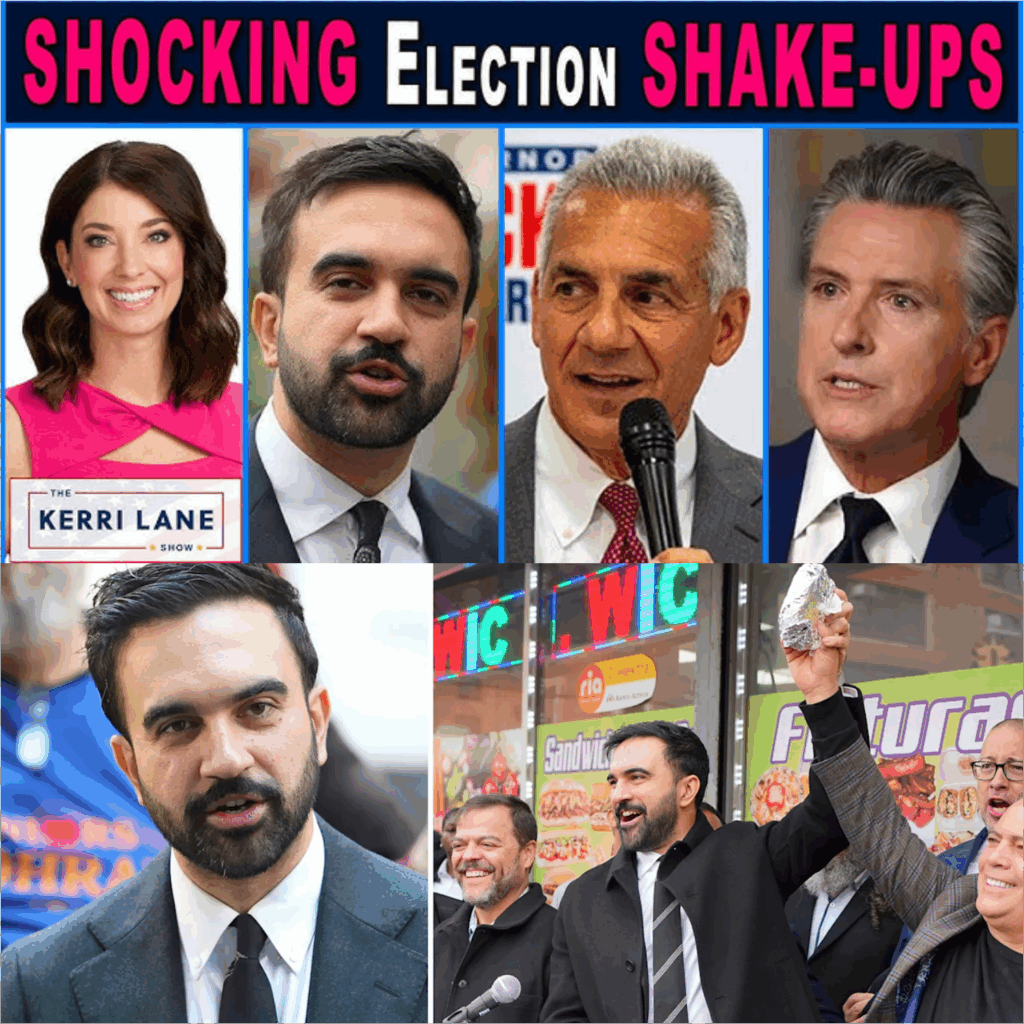
As Election Eve descends, the political landscape is erupting with late-stage controversies, dramatic campaign moments, and stark revelations about political funding. From California Governor Gavin Newsom’s perceived presidential aspirations and policy maneuvers to the surprising financial backing of New York mayoral candidate
California Governor Gavin Newsom, widely speculated to be a contender for the 2028 presidential race, faced intense scrutiny over his recent public behavior, characterized by critics as “TDS” (Trump Derangement Syndrome).
Newsom was called out on NBC by Kristen Welker for imitating President Donald Trump’s online tactics, including the use of “all cap posts” and “similar memes” (1:11–1:15). Newsom vehemently denied that this was normalizing the behavior, arguing instead that he was trying to put a
Critics, however, dismissed this as a desperate move by an ambitious politician. Commentators argued that Newsom simply became the
The most damning criticism against Newsom was his blatant flip-flop on his interest in the presidency. Just one week prior, Newsom stated he would be
This dramatic reversal was labeled a “pathological lying” habit and a “national security risk” by critics like Charlie Kirk (5:36–6:12), who also described the Governor as the “fakest person I think I’ve ever met in my entire life”
Further fueling accusations of hypocrisy was Newsom’s involvement in a political maneuver critics dubbed a “nuclear gerrymander” (2:49). When discussing the changes in modern politics, Newsom said,
This phrase was immediately tied to Prop 50, a proposed measure that would allow a Democrat-controlled commission to redraw districts in an already heavily Democratic state, aiming to
In New York City, mayoral candidate Zohran Mamdani’s moonshot campaign hit unexpected turbulence as an Islamist activist revealed the surprising financial engine behind his success.
Activist Linda Sarsour was captured on video openly admitting the primary financial source for Mamdani’s campaign: “It is our Muslim American communities… it’s Muslim money” (12:19–12:24).
Sarsour detailed that the PACs supporting Mamdani are comprised of
Critics immediately framed this as “foreign influence money” shaping local politics and exploited by “left-wing radicals”
Mamdani’s rise coincides with a reported surge in support for socialism among Democratic voters. A Gallup poll showed that 66% of Democrats now have a positive view of the ideology (10:40–10:49), contrasting sharply with Republicans, where 74% view capitalism positively (10:54–10:58). Critics lamented that Democrats were continuing to shift “farther and farther to the left” instead of seeking the middle ground (11:06–11:18).
As Election Day approached, several other races were highlighted, alongside instances of alleged election irregularities.
The New Jersey gubernatorial race between Trump-backed Jack Ciattarelli and Mikey Sherrill (D) was neck-and-neck, with Sherrill holding a slight edge (14:41–14:45). The state, which hasn’t seen three consecutive Democratic administrations in over a century, is a critical test. Ciattarelli was featured in a heartwarming, emotional campaign moment where his father, who serves in the military, returned overnight to vote for him (15:15–15:30).
In Virginia, Democrat Abigail Spanberger was fighting to hold a 10-point lead against Republican Winsome Earl Sears (15:58–16:03). Both candidates were pushing hard in the final hours, with the entire GOP ticket rallying behind Sears (16:17–16:26).
The report raised concerns over election integrity, citing two specific examples:
California:
Katie Porter
“handing out free stuff to young voters”
New York:
“illegally campaigning”
The segment also featured a satirical clip about a voter claiming to “illegally vote for Zohran Mamdani six times” (7:31–7:41) to underscore the need for voter ID and election monitoring, which critics claim Democrats oppose (7:44–7:48).
The overall message remains a stark choice for voters: between what critics call the “chaos” and “fantasy” of the progressive left and the perceived “sanity” and defense of American principles offered by conservatives (16:36–16:42).
The night began like any other.
Wind howled across an empty industrial park, the kind of cold that cuts through coats and silence alike. The air carried the metallic echo of faraway trains and the faint pulse of traffic from the highway.
But just after midnight, that silence broke.
Somewhere on the outskirts of Chicago, a cluster of unmarked SUVs rolled through Broadview — their headlights dimmed, radios muted. The officers inside were used to routine. They’d been through worse nights. But this one would unfold into something no one expected.
Within minutes, a convoy of civilian vehicles appeared out of nowhere. Ten of them, witnesses would later say — dark sedans and pickup trucks moving in tight formation, cutting through the streets like a shadow army.
What happened next would ignite a national firestorm.
By dawn, there were gunshots, flashing lights, and blood on the asphalt.
And at the center of it all — federal agents trapped outside a U.S. government facility.
According to initial reports, the confrontation began at approximately 12:40 a.m. Friday, less than two blocks from a federal building in Broadview, Illinois.
Federal officers from the Department of Homeland Security’s enforcement division were conducting a late-night perimeter patrol. Moments later, they were boxed in.
Ten vehicles surrounded them — front, rear, and both flanks — engines revving in unison. One rammed a patrol car from behind, another blocked the exit route. The officers were trapped, their vehicles pinned and unable to maneuver.
Inside one of the federal SUVs, an agent shouted into his radio:
“We’re blocked in! Multiple vehicles, multiple drivers — request immediate backup!”
But by then, the ambush had already begun.
Witnesses described the scene as “sudden and explosive.” Tires screeched. One protester reportedly swung a baseball bat at a side mirror while others shouted obscenities. Then came something far worse — a glint of metal.
A woman stepped out of one of the vehicles holding what agents believed to be a semi-automatic pistol.
In the seconds that followed, chaos erupted.
Officers exited their vehicles, seeking cover behind open doors. Shouts turned into commands. Someone yelled, “Gun! Gun!”
According to DHS Assistant Secretary Tricia McLaughlin, the agents “were forced to deploy their weapons and fire defensive shots.”
The armed suspect — later identified as a U.S. citizen already on a CBP security watchlist — fled the scene, injured. She drove herself to a nearby hospital, where police took her into custody.
The gunfire near the Broadview facility wasn’t random.
For weeks, the site had been the focus of escalating anti-ICE demonstrations — nightly protests that had grown increasingly violent.
What began as chants and signs quickly spiraled into blockades, tire-slashing, and vandalism. Some demonstrators had reportedly shared tactical guides online, detailing how to surround and disable federal vehicles.
It wasn’t just local activists anymore. According to DHS intelligence briefings reviewed by Fox News, “organized extremist networks” were now blending with far-left protest groups, pushing a coordinated campaign against federal immigration enforcement.
The woman shot on Friday was among them.
Officials say she had been flagged days earlier for posting on social media:
“Hey to all my gang — let’s [expletive] those mother ***ers up. Don’t let them take anyone.”
Her name appeared in a Customs and Border Protection intelligence bulletin circulated internally just last week.
What infuriated federal officials most, however, wasn’t the ambush itself — it was the reaction afterward.
As the agents secured the area and set up a temporary perimeter, they waited for assistance from local authorities.
It never came.
“Pritzker’s Chicago Police Department is leaving the shooting scene and refuses to assist us,” McLaughlin said in a public statement hours later. “There is a growing crowd, and we are deploying special operations to control the scene.”
Her tone was measured, but the frustration was unmistakable. To DHS officials, the lack of cooperation represented a complete breakdown between city and federal law enforcement.
Broadview’s ICE detention center has long been a flashpoint — a place where federal policy collides with Chicago’s sanctuary-city politics.
In recent months, nightly crowds of several hundred had gathered outside its gates. Some carried handmade banners that read “Abolish ICE” and “Freedom for All.” Others threw rocks, bottles, and paint-filled balloons at officers.
Local media initially downplayed the violence, describing the gatherings as “mostly peaceful.” But internal DHS logs tell a different story — at least 37 separate incidents of property destruction, 14 vehicle attacks, and six injuries among officers over the past three weeks alone.
Friday night’s ambush was the boiling point.
By sunrise, federal reinforcements from the ATF and U.S. Border Patrol had arrived. Tactical units in body armor fanned out across the industrial district, securing intersections and escorting remaining ICE personnel back inside the compound.
The crowd outside chanted louder.
Helicopters hovered overhead.
And across the country, Americans woke up to breaking-news alerts about federal agents opening fire on U.S. citizens — the first time such a clash had occurred in the Chicago area in decades.
What no one yet understood was just how close the encounter had come to disaster.
“The Trap on Route 1: A Quiet Night in Chicago That Exploded Into Gunfire”
The night began quietly — too quietly for a city that rarely sleeps.
It was just after 2 a.m. when two unmarked federal vehicles rolled along a dimly lit stretch near Broadview, a small industrial pocket on the outskirts of Chicago. The agents inside had done this routine hundreds of times before — sweeping the perimeter of one of the region’s most volatile ICE facilities, watching for signs of coordinated protest activity.
But what awaited them that night wasn’t a protest.
It was an ambush.
At first, there was nothing unusual — just the hum of tires on asphalt and the low crackle of the radio. Then, within seconds, the dark street filled with light.
Headlights appeared from every direction — front, back, and both sides.
Ten vehicles, moving fast, boxed the agents in, slamming their brakes and cutting off every possible escape route. One SUV rammed into the lead federal vehicle, the sound of crunching metal echoing through the night. Another struck from the side, pinning the second car between two attackers.
The agents’ immediate instinct was to reverse, but the rear was sealed too.
They were trapped.
“Gun! Gun!” one of the agents yelled as a figure stepped out from the driver’s side of a white sedan. Witnesses later told investigators the suspect — a woman in her twenties — was holding a semi-automatic pistol.
Seconds later, the agents were out of their vehicles, weapons drawn. The sound of gunfire broke the stillness of the street.
It was brief, chaotic, and over almost as quickly as it began.
The armed suspect went down, wounded but alive.
She would later drive herself to a hospital — bleeding, angry, and, as authorities later revealed, already known to them.
According to Department of Homeland Security Assistant Secretary Tricia McLaughlin, the woman had already been flagged by U.S. Customs and Border Protection.
Just a week before the ambush, she had been identified in an intelligence bulletin for doxing ICE agents — publishing their personal information online — and urging others to “go after them.”
Her social media posts had been explicit.
“Hey to all my gang,” one of them read. “Let’s f*** those motherf***ers up. Don’t let them take anyone.”
To investigators, the Broadview attack now seemed less like a spontaneous act of rage and more like the execution of a plan — one that mirrored the rhetoric spreading online among extremist anti-ICE networks.
As the smoke cleared and the agents secured the scene, they realized they had another problem — they were alone.
“We called for backup,” one DHS official said. “We expected local police to arrive within minutes. But they didn’t come.”
McLaughlin’s later statement confirmed the shocking truth:
“Pritzker’s Chicago Police Department is leaving the shooting scene and refuses to assist us in securing the area.”
The refusal triggered disbelief inside federal ranks. Officers at the scene could see the flashing lights of nearby patrol cars — and yet, none moved closer.
“We had just survived an armed ambush,” said another agent. “We were outnumbered, under fire, and they just… stayed back.”
Word of the shooting spread fast. Within an hour, hundreds of protesters were back outside the Broadview ICE facility. Some shouted through bullhorns, calling the agents “murderers.” Others carried makeshift banners demanding the abolition of ICE.
Videos circulating online showed protesters surrounding federal vehicles again, banging on the hoods and blocking exits.
A few shouted that the woman shot by the agents was “a martyr.”
By dawn, federal tactical units were arriving to stabilize the situation — armored vehicles, riot gear, and barricades rolled in as agents worked to disperse the swelling crowd.
At 8 a.m., DHS officials briefed the White House. President Trump, informed of the situation, ordered immediate reinforcements from Homeland Security Investigations (HSI) and the U.S. Marshals Service.
“This administration will not tolerate organized violence against federal officers,” the statement read. “There will be no sanctuary for those who target law enforcement. Not in Chicago. Not anywhere.”
But for the agents on the ground, that assurance came hours too late.
They had already lived through the nightmare.
And for many of them, the sound of that woman’s gun — and the flash of her headlights before the collision — would replay in their minds long after the crowd was gone.


No comments: