

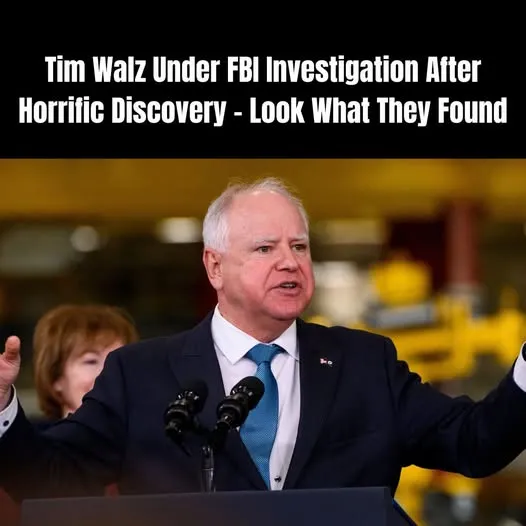
In the sterile conference rooms where Minnesota’s legislative committees conduct their business, a political reckoning was brewing that would test the credibility of one of America’s most progressive governors. What began as a well-intentioned program to help vulnerable residents secure housing had morphed into something far more sinister—a criminal enterprise that allegedly siphoned millions from taxpayers while exploiting the very people it was designed to protect.
The timing couldn’t have been worse for Governor Tim Walz. Just 24 hours after announcing his bid for a third term, promising continued progressive leadership and fiscal responsibility, he found himself fielding uncomfortable questions about how his administration had allowed such massive fraud to flourish under his watch. The answers he would provide—or fail to provide—could determine not just his political future, but the public’s faith in government programs designed to help society’s most vulnerable.
The Housing Stabilization Services program had all the hallmarks of progressive policy success when it launched. Funded through Medicaid and designed to help older adults and people with disabilities secure stable housing, it represented Minnesota’s commitment to supporting its most vulnerable residents through government intervention and social services.
The program’s mission was straightforward and compassionate: provide assistance to individuals who might otherwise struggle to find or maintain adequate housing due to age, disability, or other circumstances. Case workers would help clients navigate the complex world of rental applications, security deposits, and housing searches, providing a crucial bridge between need and solution.
But what started as a modest program with an estimated annual cost of $2.6 million in 2017 had transformed into something unrecognizable by 2024. The program’s costs had exploded to $107 million annually—a staggering 4,000% increase that should have triggered alarm bells throughout the state bureaucracy.
This exponential growth represented more than just program expansion or increased demand. According to Department of Human Services temporary commissioner Shireen Gandhi, the program had become riddled with “credible allegations of fraud” that necessitated federal intervention to shut it down entirely.
The scale of the alleged fraud was breathtaking. Over six years, providers had billed the state approximately $100 million through the Housing Stabilization Services program. The FBI’s involvement, including raids on five Minnesota businesses in July accused of collecting millions in Medicaid payments for services never provided, suggested that this wasn’t simply administrative error or program mismanagement—it was organized criminal activity operating under the guise of social services.
The Housing Stabilization Services scandal represents just the latest in a series of major fraud cases that have plagued Minnesota under Walz’s leadership, raising serious questions about the state’s oversight capabilities and the governor’s commitment to protecting taxpayer dollars.
The most notorious case remains the Feeding Our Future scandal, which saw fraudsters exploit COVID-19 child nutrition programs to steal millions of dollars intended to feed hungry children during the pandemic. The scheme involved fake meal sites, inflated participation numbers, and elaborate kickback arrangements that diverted funds from legitimate feeding programs into the pockets of criminals.
The state’s autism program has also been targeted by fraudsters who exploited services intended to help children with developmental disabilities. These schemes not only cost taxpayers millions but potentially denied crucial services to families genuinely in need of support for their children.
Various Medicaid schemes have similarly exploited programs designed to provide healthcare services to low-income Minnesotans. The common thread connecting all these cases is the exploitation of programs specifically designed to help vulnerable populations—a particularly cruel form of fraud that victimizes both taxpayers and the intended beneficiaries of these services.
This pattern suggests systemic problems within Minnesota’s oversight mechanisms that extend beyond any single program or agency. The consistent exploitation of social service programs indicates either inadequate fraud detection systems, insufficient oversight protocols, or both.
Governor Walz’s decision to announce his bid for a third term came at a particularly inopportune moment, just one day before he would face intense scrutiny over his administration’s handling of the housing fraud scandal. The timing created an unavoidable juxtaposition between his campaign promises and the reality of his administrative record.
Campaign announcements typically focus on achievements, future plans, and positive messaging designed to energize supporters and attract undecided voters. Instead, Walz found himself immediately on the defensive, forced to explain how his administration had allowed such massive fraud to occur and why corrective action had been so slow to materialize.
The governor’s response revealed both the political challenges he faces and his administration’s approach to crisis management. Rather than taking full responsibility for the oversight failures, Walz attempted to frame the issue as an inevitable consequence of managing large government programs while highlighting steps his administration had taken to address fraud.
“You’re always gonna find people trying to cheat the system,” Walz told WCCO, a comment that seemed to minimize the scale of the problem while suggesting that such fraud was simply an unavoidable cost of doing business in government. This framing risks appearing cavalier about taxpayer money and the impact of fraud on legitimate program beneficiaries.
In a move that critics characterized as political theater, Walz signed an executive order creating a statewide Inspector General Coordinating Council just 45 minutes before a legislative hearing on the fraud allegations. The timing of this announcement raised questions about whether it represented genuine reform or merely an attempt to deflect criticism.
The executive order established a council led by the Bureau of Criminal Apprehension, but the council’s exact role and authority remained unclear even after the announcement. This lack of specificity fueled criticism that the order was more about creating the appearance of action than implementing substantive reforms.
Rep. Kristin Robbins (R-Maple Grove), chair of the fraud prevention committee, characterized the timing as suspicious. “Releasing this executive order just before today’s House Fraud Prevention and State Agency Oversight hearing appears more like a distraction than a solution,” she said in a statement.
The criticism highlights a broader concern about the independence and effectiveness of oversight mechanisms when they remain under executive branch control. Robbins argued that the new council lacks sufficient independence from the governor’s office to provide meaningful oversight, potentially creating another layer of bureaucracy without addressing underlying systemic problems.
The Republican-led House Fraud Prevention and State Agency Oversight Policy Committee’s investigation represents both legitimate oversight responsibility and political opportunity. With Rep. Robbins serving as committee chair while also running for governor, the hearings provide a platform to challenge Walz’s record while positioning herself as a fiscally responsible alternative.
The committee’s work has already yielded significant revelations about the scope of the fraud and the administration’s response. DHS Inspector General James Clark testified that the agency has suspended payments to 115 providers in the Housing Stabilization Services program, a massive number that suggests widespread abuse rather than isolated incidents.
Perhaps more damaging was Clark’s admission that DHS only responded to the fraud allegations after media coverage brought public attention to the issue. This suggests that the department’s internal oversight mechanisms had failed to detect or respond to obvious red flags in program spending and provider behavior.
The revelation that an assistant commissioner who oversaw the Housing Stabilization Services program was no longer with the department added another layer of accountability questions. While DHS Commissioner Gandhi characterized it as the end of an “appointment,” Rep. Robbins described it as a firing, highlighting disagreements about responsibility and consequences for oversight failures.
The involvement of federal authorities in investigating and ultimately shutting down the Housing Stabilization Services program represents a significant escalation that reflects poorly on state-level oversight capabilities. Commissioner Gandhi’s request for federal help to terminate the program suggests that state authorities either lacked the capability or the will to address the fraud internally.
The FBI raids on five Minnesota businesses in July marked a dramatic escalation in federal law enforcement attention to Minnesota’s fraud problems. These raids, conducted as part of investigations into millions of dollars in Medicaid payments for services never provided, demonstrated that the fraud had reached a scale that warranted serious criminal investigation.
Federal involvement also raises questions about Minnesota’s relationship with federal funding programs and oversight requirements. The state’s repeated fraud problems could potentially jeopardize future federal funding or result in increased oversight requirements that would limit Minnesota’s autonomy in administering social programs.
The decision to end the Housing Stabilization Services program entirely, pending federal approval, represents an acknowledgment that the fraud had become so pervasive that reform was impossible. This drastic step suggests that the program’s fundamental structure or oversight mechanisms were so compromised that starting over was preferable to attempting repairs.
Governor Walz and his administration have pointed to various reforms implemented in response to the fraud allegations, including expanded data-sharing among agencies and the appointment of an inspector general within DHS. However, critics argue that these changes represent reactive rather than proactive governance.
The administration’s new “aggressive” approach to suspected fraud, including halting payments when fraud is suspected and immediately notifying law enforcement, represents a significant departure from previous practices. DHS Inspector General Clark acknowledged that the department had previously continued payments to avoid alerting suspects, a policy that prioritized investigation over fraud prevention.
This policy change raises questions about why such an obvious reform wasn’t implemented earlier, especially given the pattern of fraud cases across multiple state programs. The acknowledgment that the department was previously continuing payments to suspected fraudsters suggests either poor judgment or inadequate fraud detection capabilities.
The expanded data-sharing initiatives between agencies represent another reform that critics argue should have been standard practice from the beginning. The ability to cross-reference claims and provider information across programs seems like a basic fraud prevention measure that should have been implemented when these programs were established.
Governor Walz’s comments about wishing for additional AI tools to combat fraud highlighted another dimension of Minnesota’s oversight challenges. His admission that the state lacks modern technological resources for fraud detection suggests that Minnesota’s systems are outdated compared to the sophisticated methods employed by modern fraudsters.
“The one thing I wish we would have got it, there are some AI tools out there that would help us on this,” Walz told WCCO, acknowledging that the state’s fraud detection capabilities lag behind available technology. This technological gap may partly explain how such massive fraud schemes operated undetected for so long.
The comment also raises questions about budget priorities and resource allocation within state government. If AI tools for fraud detection are available and could save millions of taxpayer dollars, why weren’t they prioritized in previous budget cycles? The cost of such technology would likely be minimal compared to the losses from fraud that could have been prevented.
The reliance on media coverage to expose fraud problems suggests that Minnesota’s current detection systems are inadequate for the scale and sophistication of modern fraud schemes. Advanced analytics and artificial intelligence could potentially identify unusual patterns in spending or provider behavior before fraud reaches the scale seen in recent Minnesota cases.
The fraud scandals present significant political vulnerabilities for Governor Walz as he seeks a third term. Beyond the immediate financial costs to taxpayers, the pattern of oversight failures raises broader questions about his administration’s competence and commitment to fiscal responsibility.
Rep. Robbins, as both committee chair investigating the fraud and a gubernatorial candidate, is positioned to make these oversight failures a central theme of her campaign. Her criticism of Walz’s executive order as “more like a distraction than a solution” suggests that she intends to frame the governor as reactive rather than proactive in addressing systemic problems.
The political damage extends beyond specific fraud cases to broader questions about government effectiveness and the proper role of social programs. If voters conclude that well-intentioned programs consistently become vehicles for fraud under Walz’s leadership, it could undermine support for progressive policy initiatives more broadly.
The governor’s promise that “if you commit fraud in Minnesota, you will be prosecuted and held accountable to the fullest extent of the law” rings hollow given the scale of fraud that operated undetected under his administration. This credibility gap could prove difficult to overcome in a competitive election.
The Minnesota fraud scandals have implications that extend beyond state politics to broader questions about public trust in government programs and social services. When programs designed to help vulnerable populations become vehicles for criminal exploitation, it undermines public support for the social safety net.
The exploitation of programs serving children, disabled individuals, elderly residents, and other vulnerable populations represents a particularly damaging form of fraud that erodes public confidence in government’s ability to effectively serve those most in need. Each fraudulent claim not only costs taxpayers money but potentially denies services to legitimate beneficiaries.
The pattern of fraud across multiple programs suggests systemic weaknesses in oversight and program design that could affect similar programs in other states. The Minnesota cases may serve as cautionary tales for other state administrations about the importance of robust fraud prevention measures from program inception.
The federal government’s involvement in shutting down state programs also raises questions about the balance between state autonomy and federal oversight in administering federally funded programs. If states consistently fail to prevent fraud, federal authorities may impose additional requirements that limit state flexibility.
As Minnesota moves forward from these fraud scandals, several key questions remain about the effectiveness of proposed reforms and the likelihood of preventing future abuse. The success of new oversight mechanisms will depend on their independence, resources, and authority to investigate and prevent fraud.
The creation of additional inspector general positions and coordinating councils may help improve oversight, but only if these entities have sufficient independence from the political pressures that may have contributed to previous oversight failures. The criticism that new oversight mechanisms remain too closely tied to the executive branch suggests that structural reforms may be necessary.
The implementation of modern technology tools for fraud detection represents another crucial element of preventing future abuse. However, technology alone cannot substitute for adequate staffing, proper training, and a commitment to aggressive fraud prevention rather than merely reactive investigation.
The political consequences of these fraud scandals may ultimately prove more significant than the financial costs. If voters conclude that the Walz administration has failed to protect taxpayer interests and ensure program integrity, it could reshape Minnesota politics and influence approaches to social programs nationwide.
The fraud scandals plaguing Minnesota under Governor Tim Walz’s leadership represent more than just financial losses—they reflect fundamental failures in government oversight and program administration that undermine public trust and harm vulnerable populations.
The pattern of exploitation across multiple programs suggests systemic problems that extend beyond any single agency or administrator. The consistent targeting of programs designed to help society’s most vulnerable members represents a particularly cruel form of fraud that victimizes both taxpayers and intended beneficiaries.
As Governor Walz seeks a third term, his handling of these fraud scandals will likely serve as a key measure of his administrative competence and commitment to fiscal responsibility. The reactive nature of his administration’s response, combined with the scale of the fraud that operated undetected, presents significant political vulnerabilities.
The broader implications of Minnesota’s fraud problems extend to questions about government effectiveness, program design, and the proper balance between serving vulnerable populations and protecting taxpayer interests. The resolution of these issues will influence not only Minnesota’s political future but potentially the national conversation about social programs and government oversight.
The ultimate test of the Walz administration will be whether the proposed reforms prove effective in preventing future fraud or whether Minnesota continues to serve as a cautionary tale about the consequences of inadequate oversight in an era of sophisticated criminal schemes targeting government programs.
As Congress hurtles toward another government shutdown, a tense exchange between Representative Maxine Waters and a reporter has intensified the debate over whether Democrats are tying federal funding negotiations to taxpayer-financed healthcare for undocumented immigrants.
The clash unfolded on Capitol Hill Tuesday, just hours before a midnight deadline to pass a continuing resolution that would have kept the government open.
The deadline passed without resolution after a Senate vote failed to secure the 60 votes required for passage. Although three Senate Democrats broke ranks to side with Republicans in supporting a House-passed measure, the effort fell short 55–45.
The failure triggered a shutdown and set off a new round of partisan finger-pointing over who was to blame and what priorities derailed the process.
Waters, a California Democrat and senior member of her caucus, found herself at the center of controversy following an interview with Lindell TV reporter Alison Steinberg. Her comments, and the heated way in which she defended them, have become emblematic of the larger divide in Washington.
Steinberg pressed Waters on whether Democrats were prioritizing healthcare for illegal immigrants over keeping the government open. At first, Waters sought to avoid a direct answer, stressing instead that healthcare remained a top priority for her party in negotiations.
“But are Democrats demanding health care for illegal aliens?” Steinberg asked pointedly.
“Democrats are demanding health care for everybody,” Waters responded. “We want to save lives. We want to make sure that health care is available to those who would die but having the help of their government.”
Her words were interpreted by some as an admission that Democrats intended to include undocumented immigrants in their healthcare demands. Steinberg followed up, asking if Waters would support a shutdown “even if it means giving healthcare to people who aren’t Americans.”
That line of questioning provoked frustration. “What you’re trying to do is you’re standing here and you’re trying to make me say that somehow we’re going to put non-citizens over Americans,” Waters snapped. “Quit it. Stop it. This is the kind of journalism we don’t need. You’re divisive.”
The exchange quickly circulated online, drawing cheers from Democratic supporters who praised Waters for refusing to be cornered, but also heavy criticism from Republicans who seized on her statements as proof of misplaced priorities.
The failed vote marked the latest stalemate in a Congress increasingly defined by gridlock. The House Republican measure that fell short was intended to extend government funding until November 21 while maintaining previously agreed-upon spending levels. Republicans framed it as a “clean” bill, free of additional demands.
Democrats, however, pushed for the inclusion of provisions tied to healthcare, including a permanent renewal of Affordable Care Act tax credits and, according to Republicans, provisions that would extend taxpayer-funded care to undocumented immigrants.
Vice President JD Vance, speaking after a White House meeting with legislative leaders, blasted the Democratic approach. “If you look at the original they did with this negotiation, it was a $1.5 trillion spending package, basically saying the American people want to give massive amounts of money, hundreds of billions of dollars to illegal aliens for their health care, while Americans are struggling to pay their health care bills,” Vance said.
“That was their initial foray into this negotiation. We thought it was absurd.”
Republicans have insisted that the focus should be on lowering costs rather than continuing subsidies without reform. By linking funding to broader healthcare demands, Democrats, in the GOP’s view, engineered a stalemate that inevitably resulted in a shutdown.
While most Senate Democrats stood with Majority Leader Chuck Schumer in rejecting the House bill, three broke ranks: Senator Catherine Cortez Masto of Nevada, Senator John Fetterman of Pennsylvania, and Senator Angus King of Maine, an independent who caucuses with Democrats.
Their votes highlighted cracks in Democratic unity and signaled growing unease among moderates about being seen as obstructing a straightforward funding measure.
Even so, the defections were not enough. With the measure falling short of the 60 votes needed to advance, the shutdown became unavoidable. Republicans have indicated they will reintroduce the bill on Wednesday, believing that additional Democrats might cross over in order to quickly reopen the government.
Such a move would represent a major blow to Schumer’s leadership and potentially shift the political dynamics heading into the next legislative battles.
President Donald Trump, speaking to reporters earlier Tuesday, emphasized the stakes of the showdown. “Thousands of federal workers could face permanent job losses if Democrats proceed in a way that triggers a shutdown,” Trump warned.
His remarks underscored the administration’s determination to frame Democrats as responsible for the disruption.
Trump and Vance have repeatedly hammered Democrats for seeking to prioritize non-citizens in spending negotiations, a charge Democrats have denied but struggled to fully shake off. The optics of Waters’ exchange with Steinberg provided Republicans with fresh material to reinforce their narrative.
At the core of the dispute lies the issue of healthcare, a perennial battleground in American politics. Democrats argue that universal access should extend to everyone, including undocumented immigrants, as a matter of public health and morality.
Waters’ comments reflected that position, though critics accused her of dodging the question of whether such policies should come at the cost of keeping the government open.
Republicans counter that taxpayer-funded healthcare should be strictly reserved for American citizens. They argue that extending benefits to undocumented immigrants not only places undue strain on resources but also undermines efforts to control healthcare costs for citizens already struggling with high premiums and out-of-pocket expenses.
By tying the funding extension to healthcare provisions, Democrats elevated the issue from a policy debate to the central factor in a government shutdown, making it a high-stakes political gamble.
Already, the shutdown has become a messaging war. Republicans quickly branded the funding lapse as the “Schumer shutdown,” echoing past tactics where blame is pinned on congressional leaders.
Schumer, for his part, accused Republicans of refusing to engage in serious negotiations, but his argument was undercut by Democratic defections in the Senate vote.
For Waters, the viral interview placed her squarely in the spotlight. While her fiery rhetoric resonates with her base, it also feeds into Republican portrayals of Democrats as prioritizing outsiders over citizens. The moment may energize partisans on both sides, but it complicates Democratic efforts to unify their messaging.
With Republicans planning to bring the funding measure back for another vote, the immediate question is whether additional Democrats will join the three who already broke ranks.
If so, the government could reopen quickly, though at the expense of Schumer’s leverage and the healthcare demands Democrats have sought to include.
For now, the standoff continues, with federal workers caught in the crossfire and public patience wearing thin. Each day of a shutdown carries economic consequences, from delayed paychecks to disrupted services. Politically, the longer it drags on, the greater the risk that one party will be saddled with the blame.
The government shutdown reflects a broader clash over the priorities of Congress and the allocation of taxpayer dollars. For Democrats, the pursuit of expanded healthcare access — potentially including undocumented immigrants — has become a defining demand.
For Republicans, the insistence on a “clean” funding bill without such provisions is both a political strategy and a policy stance.
The explosive exchange between Maxine Waters and a reporter symbolized the raw emotions at play and the difficulty of crafting compromise in today’s hyperpartisan climate.
Whether Democrats can hold their caucus together, and whether Republicans can maintain their own unity, will determine how long the shutdown lasts and who emerges politically stronger.
For now, one fact is clear: the debate over healthcare, immigration, and federal spending has once again paralyzed Washington, leaving millions of Americans uncertain about the future of their government and its ability to function.


No comments: