

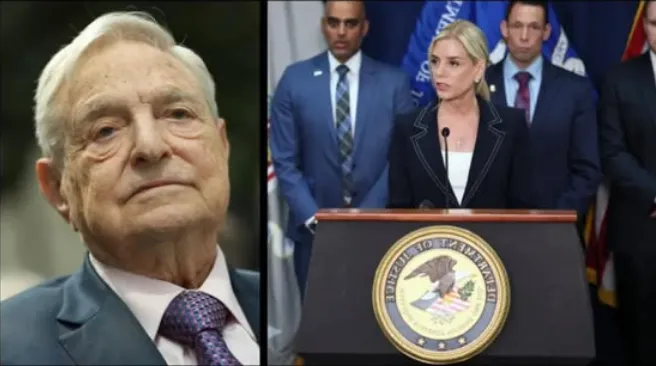
A new investigative report alleges that George Soros’s Open Society Foundations (OSF), now run with his son Alexander, have directed over $80 million since 2016 to groups linked to extremist violence, domestic terrorism, or foreign terrorist organizations.
According to the report from the Capital Research Center (CRC), at least $23 million went to seven U.S.-based groups that engaged in activities the FBI defines as domestic terrorism, such as property destruction, sabotage, and economic disruption.
These included the Center for Third World Organizing and its militant partner the Ruckus Society, which trained activists in destructive tactics during the 2020 riots, and the Sunrise Movement, which endorsed the Antifa-linked “Stop Cop City” campaign where more than 40 activists face terrorism charges and over 60 face racketeering indictments.
Open Society also awarded $18 million to the Movement for Black Lives, which co-authored a radical guide glorifying Hamas’s October 7, 2023 massacre and providing instructions for activists on using false IDs, staging blockades, and disrupting commerce.
Internationally, Soros’s foundation has funneled more than $2.3 million into Al-Haq, a West Bank NGO accused for decades of ties to the Popular Front for the Liberation of Palestine (PFLP), a U.S.- and EU-designated terrorist group.
In September 2025, the U.S. State Department officially sanctioned Al-Haq for advancing campaigns that “directly engaged in the ICC’s illegitimate targeting of Israel.” That designation means OSF financed an entity now formally blacklisted by Washington.
In total, the report documents OSF grants to at least 54 organizations that either: Directly assisted domestic terrorism in the U.S.; Endorsed or are linked to foreign terrorist organizations, or Provided material support to groups aligned with pro-terror causes.
“This investigation documents how Open Society’s philanthropy blurs into complicity—fueling groups that celebrate violent uprisings, train militants, and endorse terrorist movements,” the report states. “The findings raise urgent questions for Congress, federal investigators, and the IRS about whether Soros’s flagship foundation, and its grantees, can continue to operate with tax-exempt status while bankrolling criminality at home and sanctioned entities abroad.”
CRC noted that U.S. law prohibits nonprofits from maintaining tax-exempt status if they fund or facilitate illegal activity. The IRS has explicitly said that groups encouraging unlawful blockades or seizures of property fall outside the scope of permissible charitable work.
The report argues OSF’s giving represents “a systemic pattern of empowering groups that glorify violence and destabilize societies.” It concludes the evidence could support action under federal racketeering statutes, revocation of tax exemptions, and further scrutiny by Congress or the Justice Department.
President Trump has already pledged to pursue racketeering charges against Soros and his network. “We’re going to look into Soros because I think it’s a RICO case against him and other people,” Trump said in a recent Fox News interview.
The Open Society Foundations has rejected such allegations in the past, saying it “does not support or fund violent protests” and calling threats of prosecution “outrageous.”
The CRC report has added momentum to calls for oversight. Republican lawmakers have signaled interest in holding hearings on OSF’s U.S. tax status and foreign entanglements. Some have floated revoking its nonprofit status, which would cut off significant tax advantages.
The stakes could be high: CRC notes that if the federal government determines OSF’s giving knowingly aided terrorism or domestic crime, penalties could include loss of tax exemption, civil liability, or even criminal prosecution under RICO or material support statutes.
“The evidence is stark,” the CRC report concludes. “Open Society has financed groups that glorify violence, destabilize societies, and partner with organizations that are openly hostile to the United States and its allies.”
For now, OSF remains one of the largest private philanthropic entities in the world, with assets estimated at over $25 billion. Whether its grantmaking practices will draw legal consequences may depend on whether the Justice Department and Congress act on the latest findings.
The political and legal battle over the Georgia election interference case reached a new boiling point this week after the state’s highest court rejected Fulton County District Attorney Fani Willis’ attempt to return to prosecuting the case.
The decision has not only halted Willis’ effort to resume control but also sparked a furious response from President Donald Trump, who accused her of criminal behavior and demanded that she be prosecuted.
The ruling and Trump’s subsequent comments mark the latest escalation in one of the most closely watched legal dramas in the nation.
At stake is not only the future of a sprawling racketeering case targeting Trump and several of his allies but also broader questions about prosecutorial conduct, judicial oversight, and the politicization of criminal law in America.
The Georgia Supreme Court’s ruling represented a significant setback for Willis, who had been fighting to maintain her authority in the high-profile election interference case.
Earlier this year, a lower court decision had questioned her ability to continue after revelations surfaced about her personal and professional relationship with special prosecutor Nathan Wade, whom she had appointed to the case.
Willis had appealed the disqualification ruling, arguing that her removal would undermine the integrity of the prosecution and reward what she described as politically motivated attacks. But the state’s highest court disagreed, issuing a firm rejection that effectively bars her from rejoining the case.
In its opinion, the court emphasized that public confidence in the fairness and impartiality of criminal prosecutions is paramount. “Where the appearance of impropriety is unavoidable, even the most skilled prosecutor must be held to standards that preserve trust in the judiciary,” the court wrote.
The ruling immediately prompted celebration in Trump’s camp. Speaking to supporters and reporters, Trump lashed out at Willis, accusing her of abusing her office for political gain.
“Fani Willis is a criminal,” Trump declared. “She should be prosecuted for what she has done. She tried to rig the system against me, and the Georgia Supreme Court just told her no. She is the one who has broken the law.”
The President’s remarks, characteristically blunt and incendiary, reflect his ongoing strategy of turning legal challenges into political weapons. By labeling Willis a criminal, Trump not only attacked her personally but also sought to cast the entire prosecution as illegitimate and corrupt.
The Fulton County case stems from Trump’s alleged efforts to overturn the results of the 2020 presidential election in Georgia. At the heart of the allegations was the now-famous phone call to Secretary of State Brad Raffensperger, in which Trump urged officials to “find” enough votes to reverse his defeat.
Willis had assembled a sweeping racketeering case against Trump and more than a dozen co-defendants, accusing them of participating in a coordinated effort to subvert the election. The charges included conspiracy, solicitation of election fraud, and false statements.
The case was heralded by many legal experts as one of the most comprehensive attempts to hold Trump accountable for his post-election actions.
But the revelations about Willis’ personal ties to Wade complicated the narrative, allowing Trump and his allies to argue that the case was tainted by conflicts of interest.
Willis faced mounting criticism earlier this year when court filings revealed she had a romantic relationship with Wade, whom she had hired as a special prosecutor in the election case.
Though she insisted the relationship had no bearing on her professional judgment, opponents seized on the revelation as evidence of ethical lapses.
Defense attorneys argued that the relationship created an appearance of impropriety and compromised the fairness of the prosecution. The lower court’s ruling agreed, effectively sidelining Willis and forcing the state to appoint alternative leadership for the case.
Her appeal to the Georgia Supreme Court represented her last chance to reassert control, but the rejection leaves her reputation deeply damaged and her future in doubt.
Trump’s labeling of Willis as a “criminal” fits within his broader legal and political playbook. In multiple ongoing cases—from federal charges over classified documents to state-level proceedings—Trump has sought to delegitimize prosecutors and judges by portraying them as corrupt actors in a partisan conspiracy.
By framing himself as the victim of political persecution, Trump not only rallies his supporters but also undermines public faith in the legal process. His comments about Willis are the latest example of this strategy, designed to shift the narrative from his alleged conduct to the supposed misconduct of his accusers.
Republican leaders in Georgia quickly echoed Trump’s criticism of Willis. Several lawmakers called the Supreme Court ruling a victory for justice and demanded further investigation into Willis’ conduct. Some went so far as to suggest she should face disciplinary proceedings or even criminal charges for misuse of public resources.
Democrats, however, condemned Trump’s attacks as reckless and dangerous. “Calling a prosecutor a criminal simply because she pursued accountability for his actions is beyond the pale,” one Georgia Democratic leader said. “This is about undermining the rule of law.”
Civil rights organizations also voiced concern, warning that the attacks on Willis reflected broader efforts to intimidate Black women in positions of authority.
“The language used against Fani Willis is not just about this case—it is about silencing a generation of leaders who dare to hold powerful men accountable,” one activist group said.
The immediate question now is what happens to the underlying case. With Willis barred from returning, state officials must determine who will oversee the prosecution moving forward.
Legal observers note that while the disqualification weakens the case politically, the evidence gathered by Willis’ team remains intact.
“The facts don’t change just because a prosecutor is removed,” one legal analyst explained. “The charges remain, the witnesses remain, and the evidence remains. The case will go forward, but it will do so without Fani Willis.”
Still, the loss of Willis could create delays, procedural complications, and new opportunities for defense attorneys to challenge the legitimacy of the prosecution.
Public opinion remains sharply divided. Trump supporters celebrated the court ruling as proof that their candidate is being unfairly targeted. “This is a victory for fairness,” one supporter said outside a Trump rally. “Finally someone is standing up to corrupt prosecutors.”
Critics of Trump, however, argued that the ruling represents a setback for accountability and a dangerous precedent for future prosecutions of powerful figures.
“If every prosecutor can be sidelined over personal issues, then no one will ever be able to hold Trump accountable,” one critic warned.
The Willis episode carries implications far beyond Georgia. It underscores the fragility of major prosecutions in politically charged environments, where even the appearance of impropriety can derail high-stakes cases.
It also highlights the growing willingness of politicians to attack individual prosecutors as part of broader battles over accountability.
Legal scholars caution that the erosion of public confidence in prosecutorial independence could weaken the entire justice system. “When prosecutors are discredited not because of the facts of their cases but because of personal attacks, the rule of law suffers,” one professor said.
For Trump, the Georgia Supreme Court’s ruling and his ability to seize on it as a political win add momentum to his ongoing efforts to cast all investigations into his conduct as partisan witch hunts.
His declaration that Willis is a “criminal” reflects his confidence in using aggressive rhetoric to turn setbacks into victories.
Whether this strategy will ultimately help him in the courtroom remains to be seen. But politically, it has once again allowed him to control the narrative and galvanize his base.
The Georgia Supreme Court’s rejection of Fani Willis’ appeal has reshaped the trajectory of one of the most important election interference cases in American history.
For Trump, it was an opportunity to lash out, accuse Willis of criminal behavior, and rally supporters. For Willis, it was a devastating blow to her credibility and career.
The case itself remains alive, but its future is uncertain. What is clear, however, is that the battle over accountability for the events of 2020 is far from over.
As the nation watches, the clash between Trump, prosecutors, and the courts continues to test the resilience of American democracy and the limits of its legal system.


No comments: