

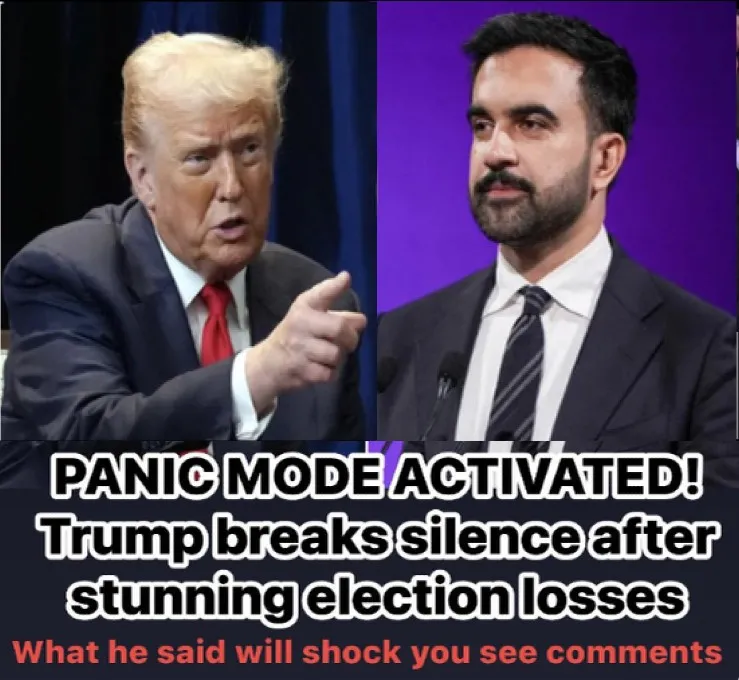
President Trump pointed to “pollsters” who say the government shutdown — combined with the fact that his name wasn’t on Tuesday’s ballot — were key reasons behind the Republican losses on Election Day.
“‘TRUMP WASN’T ON THE BALLOT, AND SHUTDOWN, WERE THE TWO REASONS THAT REPUBLICANS LOST ELECTIONS TONIGHT, according to Pollsters,” Trump posted on Truth Social on Tuesday night.
Republicans lost major races on Tuesday, though the vast majority of them were in deep blue states and districts.
In New York City, socialist candidate Zohran Mamdani defeated a rare bipartisan coalition that had rallied behind former Governor Andrew Cuomo (D) to win the mayor’s race.
Out west, California voters approved Proposition 50, effectively dismantling the state’s two-decade-old independent redistricting system. The measure clears the way for a new congressional map that could hand Democrats as many as five additional House seats in the 2026 midterm elections.
“It was not expected to be a victory. I don’t think it was good for Republicans. I’m not sure it was good for anybody, but we had an interesting evening, and we learned a lot,” Trump said at a Wednesday morning breakfast with GOP senators.
In New Jersey, a race that many expected to be close turned into a decisive win for Democrat Mikie Sherrill, who defeated Republican Jack Ciattarelli by a double-digit margin — 56.2% to 43.2% — with 95% of ballots counted as of Wednesday morning.
In Virginia, Democrat Abigail Spanberger also scored a commanding victory, defeating Republican Winsome Earle-Sears by more than 15 points, 57.5% to 42.3%, with 96% of votes tallied.
For comparison, former President Donald Trump lost both states in the previous year’s election — by 5.7 points in Virginia and 5.9 points in New Jersey,
House Republicans are exploring legal and constitutional strategies to block Mamdani from being sworn into office, citing the Constitution’s post–Civil War “insurrection clause.”
The effort, first reported by the New York Post, is being led in part by the New York Young Republican Club, which argues that Mamdani’s past statements calling to “resist ICE” and his ties to left-wing organizations could qualify as “giving aid or comfort to the enemies” of the United States — language drawn directly from Section 3 of the 14th Amendment.
That provision, enacted in 1868, bars from public office any person who has “engaged in insurrection or rebellion” against the United States, or who has provided “aid or comfort” to its enemies.
The clause was originally intended to prevent former Confederate officials from holding office but has recently re-emerged in political debates over ballot eligibility.
“There is a real and legitimate push to see the insurrectionist Zohran Mamdani either a) removed from the ballot or b) removed from office if he is to win on Tuesday,” said Stefano Forte, president of the New York Young Republican Club.
Several House Republicans are said to be reviewing whether the clause could be enforced through new legislation or congressional action following the election.
The idea mirrors the legal arguments used in Colorado last year to try to disqualify Trump from the state’s ballot — a move the Supreme Court ultimately overturned, ruling that Congress, not individual states, has the constitutional authority to enforce Section 3.
The Court’s decision has emboldened some GOP lawmakers who believe the ruling effectively places responsibility for such enforcement in the hands of Congress, where Republicans currently hold a narrow 219–213 majority in the House.
According to two congressional aides, Republican leaders may consider holding a post-election vote to declare Mamdani ineligible for office under the clause. Such a measure would face significant procedural and legal hurdles, including a likely filibuster in the Democrat-controlled Senate and near-certain court challenges.
In a dramatic hearing that has sent shockwaves through Washington, Representative Jim Jordan presented explosive evidence that could potentially dismantle the credibility of key Democratic figures, particularly Adam Schiff. The session, focused on FBI oversight, quickly escalated into a powerful confrontation as Jordan and former aide Cash Patel revealed a web of corruption, political manipulation, and cover-ups within the intelligence community. This article delves into the details of the hearing, the evidence presented, and the implications for those involved.
The hearing commenced with Jordan outlining the significant findings brought to light by Director Patel. He emphasized the shocking revelation that Adam Schiff, the former chair of the House Intelligence Committee and now a U.S. senator, had allegedly leaked classified information. This accusation stemmed from a whistleblower with 23 years of experience in the intelligence community, who claimed they were pressured to leak false information aimed at undermining then-President Donald Trump.
“Why would the head of the intelligence committee, who is supposed to protect our nation’s secrets, encourage the leaking of classified information?” Jordan asked, setting the stage for a deep dive into the alleged misconduct.
The whistleblower’s testimony was pivotal, stating that the leaked information was intended to be used to indict Trump. This assertion raised serious questions about the integrity of Schiff’s actions and the motivations behind them. Jordan underscored the gravity of the situation, suggesting that instead of safeguarding national secrets, Schiff had used his position to further a political agenda.
The hearing took a more intense turn as Jordan shifted focus to former FBI Director James Comey. He referenced the Inspector General’s report, which confirmed that Comey had violated FBI policy by disclosing classified information. “Comey’s motive was the same as Schiff’s: to sabotage Trump’s presidency,” Jordan asserted.
Jordan accused Comey of being part of a broader conspiracy to undermine Trump’s administration. He recounted Comey’s admissions about his objectives, which were not only to investigate but also to influence the political landscape during Trump’s first term. The evidence presented suggested a coordinated effort among top intelligence officials, including John Brennan and Jim Clapper, to rewrite assessments regarding Russian interference in the 2016 election.
In a particularly striking email exchange, Admiral Rogers, the head of the NSA, expressed concerns about the integrity of the intelligence assessments being pushed by his colleagues. His apprehensions were dismissed in a reply from Clapper, who insisted on maintaining a unified front, stating, “It is essential that we be on the same page and are supportive.” This exchange highlighted the pressure to conform to a narrative that was politically motivated rather than factually accurate.
The heart of Jordan’s argument lay in the assertion that the intelligence community had manipulated information to create a false narrative about Russian interference in the election. He pointed to a meeting that took place in December 2016, where officials decided to alter the assessment that initially indicated Russia did not impact the election vote count. Instead, they crafted a new narrative claiming that Russia had indeed influenced the election, which was subsequently published in January 2017.
This alteration of facts, Jordan argued, was part of a calculated strategy to undermine Trump from the very beginning of his presidency. He emphasized that the discredited Steele dossier, funded by the Clinton campaign, was central to this effort. Despite being aware of its dubious origins, intelligence officials used the dossier to brief Trump and leaked its contents to the media, igniting the Russia investigation.
Cash Patel, who served as a key aide during the Trump administration, received significant praise during the hearing for his role in exposing these corrupt practices. He had spearheaded a strike force that investigated potential crimes related to the misuse of intelligence. His efforts led to the removal of 21,000 violent criminals from the streets, the rescue of 4,000 children, and the arrest of 1,300 predators.
Patel’s testimony also revealed shocking details about the FBI’s handling of informants during the January 6 Capitol riots. He disclosed that 26 informants were present inside the Capitol that day, yet none faced charges, contrasting sharply with the treatment of regular citizens involved in the protests. This discrepancy raised serious questions about the FBI’s priorities and the political motivations behind their actions.
The hearing did not spare FBI Director Christopher Wray from scrutiny. Patel presented evidence that Wray had withheld critical information from Congress regarding the FBI’s surveillance of various groups, including Catholics. He accused Wray of misleading lawmakers and downplaying significant issues within the agency.
Throughout the hearing, it became increasingly clear that Jordan and Patel were committed to exposing what they described as a corrupt system within the intelligence community. They argued that Schiff, Comey, and Wray had weaponized their positions for political gain, undermining the integrity of the institutions they were meant to protect.
As the hearing concluded, the implications of the evidence presented were profound. Jordan and Patel’s assertions raised critical questions about accountability within the intelligence community and the need for reforms to prevent such abuses of power in the future. The fallout from these revelations could have lasting effects on the reputations and careers of those implicated.
The hearing marked a significant moment in the ongoing battle between congressional Republicans and Democrats over the narrative surrounding the Trump administration and the investigations that followed. It underscored the deep divisions in American politics and the lengths to which individuals and parties might go to protect their interests.
In the wake of the hearing, the question remains: Should Adam Schiff, James Comey, and Christopher Wray be held accountable for their actions? The evidence presented by Jim Jordan and Cash Patel suggests a troubling pattern of behavior that warrants further investigation. As the political landscape continues to evolve, the call for transparency and accountability within the intelligence community has never been more urgent.
This hearing not only highlighted the need for reform but also served as a rallying cry for those advocating for integrity in government. The American public deserves to know the truth, and as Jordan and Patel fight to expose it, the stakes have never been higher. The fallout from these revelations will undoubtedly shape the future of American politics and the trust citizens place in their government institutions.


No comments: